
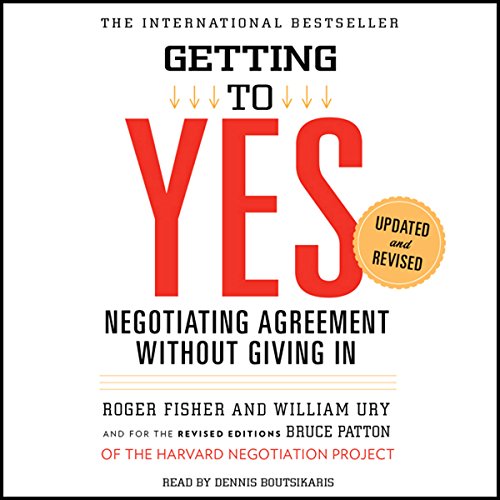
Getting to Yes by Roger Fisher, William Ury
$7.99
Getting to Yes
- Negotiating Agreement Without Giving In
- By: Roger Fisher, William Ury
- Narrated by: Dennis Boutsikaris
- Length: 6 hrs and 17 mins
- Categories: Business & Careers
Publisher's summary
Getting to Yes is a straightorward, universally applicable method for negotiating personal and professional disputes without getting taken - and without getting angry.
It offers a concise, step-by-step, proven strategy for coming to mutually acceptable agreements in every sort of conflict - whether it involves parents and children, neighbors, bosses and employees, customers or corporations, tenants or diplomats. Based on the work of the Harvard Negotiation Project, a group that deals continually with all levels of negotiation and conflict resolution, from domestic to business to international, Getting to Yes tells you how to:
- Separate the people from the problem
- Focus on interests, not positions
- Work together to create opinions that will satisfy both parties
- Negotiate successfully with people who are more powerful, refuse to play by the rules, or resort to "dirty tricks"







Blythe
Excellent book about negotiation techniques
What was one of the most memorable moments of Getting to Yes?
The examples are clear and helpful in applying the techniques to real world situations
What’s an idea from the book that you will remember?
The difference between principled and positional negotiation can be summed up quite easily in an example the author gives: two people in a library, person A wants the window closed and person B wants the window open. Two positions that are pretty much irreconcilable if the two parties simply stand by their positions and refuse to budge; there seems no way to negotiate an answer that will satisfy both. However, if the librarian comes in and looks at their interests rather than their positions, she may learn that person A wants the window open because they want fresh air (maybe the dust is making them allergic) while person B wants the window closed because he didn’t bring a jacket and will be cold in a draft. Now the librarian can offer several solutions that might resolve the disagreement – open a window further away from person B, turn up the heat, offer person A allergy medications, increase the cleaner’s schedule for dusting, etc. Looking at the interests instead of the positions may turn up several ways to resolve the dispute to both people’s satisfaction, none of which will be discovered if they insist on sticking to their principles and looking at the dispute in only that light.
Any additional comments?
This is a book about negotiation skills, and in particular what the author calls principled negotiation (considering the interests of both parties) as opposed to positional negotiation (taking positions). It’s a very interesting book, clearly explaining the weakness of positional negotiation and how to change the discussion to a more productive examination of all parties’ interests.
Something went wrong. Please try again in a few minutes.
You voted on this review!
You reported this review!
4 people found this helpful